When I finished college in the late 90s, multitasking was a skill. People put it on their resumes. Then the research came in. Nobody multitasks. We switch context, and every switch has a cost. Multitasking became a bad word.
Now I have agents. I write a task, an agent starts, and it works for an hour. What do I do in that hour?
If I wait, I waste an hour. If I take a nap, that feels wrong. If I start a second agent, an old alarm goes off in my head. Is this multitasking? Am I about to pay the switch cost the research warned about?
No. The alarm is a confusion between two different words.
Multitasking is one person who splits attention across two active tasks. The tasks live in the person's head. The cost lands on the person. The research on this is correct and still holds.
Parallelism is many workers who each hold one task. The tasks live in the workers. The person holds the queue. Nobody's attention gets split, because each worker has one thing to do.
An agent is a worker, not a task. When I start a second agent, I do not split my attention. I add a worker. The thing the research warns about does not happen.
We already know this from every other kind of work. A manager with five reports does not multitask. A conductor does not play every instrument. We only get confused when the workers are software, because for thirty years software workers did not exist.
Here is how I think about it now.
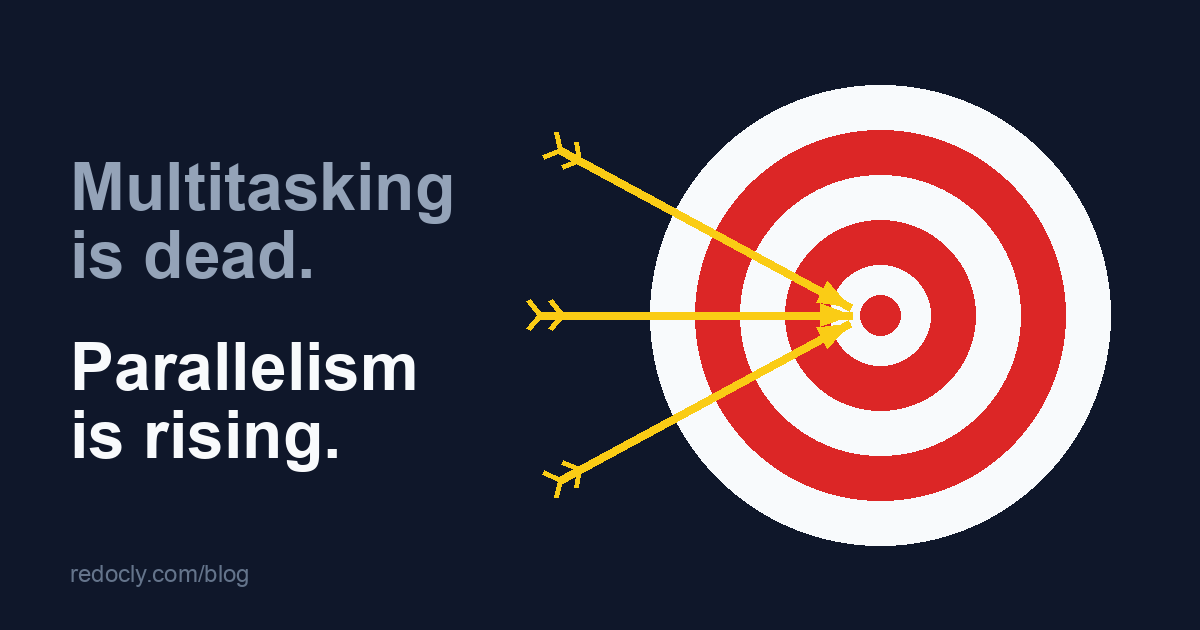
An archer aims, then releases. All the skill is in the aim. After release, the arrow goes where the aim sent it. Nobody tries to steer an arrow in flight. If the shot was bad, the archer learns, adjusts, and aims the next one.
An agent run is the same. The pitch is the aim. The hours of work are the flight. If the pitch is wrong, the output is wrong, and no amount of steering mid-flight will fix it. But a pitch is small. Two people can read it in ten minutes and find the bad assumption. The output is large and already committed to that assumption.
So put the attention at the aim. Review the pitch, not the flight. Ask the questions before release. What is the target? How will we know we hit it? Where will this go wrong? Then release, and reach for the next arrow.
An archer carries a quiver for a reason. Many arrows in flight. One aim at a time. That is parallelism in one picture.
People who fear starting several agents often skip the aim. They release quickly, then feel the weight of every arrow in flight. The fear is correct for their process. But the answer is not fewer arrows. The answer is better aim before each one.
If you cannot start a second task while the first one runs, look at how you started the first one. A task you can start in parallel has a precise target and a stop condition. If it does not, you did not aim. You threw.
The question "what do I do while my agent works" has an answer. You aim the next one. That is not multitasking. That is the job.
We spent twenty years learning to do one thing at a time. That lesson was right for a world where we were the only workers. That world is over. The new skill is not focus on one task. It is aim, release, and the discipline to aim again.