Redoc 3.0 is hereOpen source, multi‑spec, developer‑first
The #1 API docs tool, rebuilt around a unified renderer that natively supports OpenAPI, GraphQL, and AsyncAPI. Subscribe for product updates.
 Star on GitHub · 25.8k
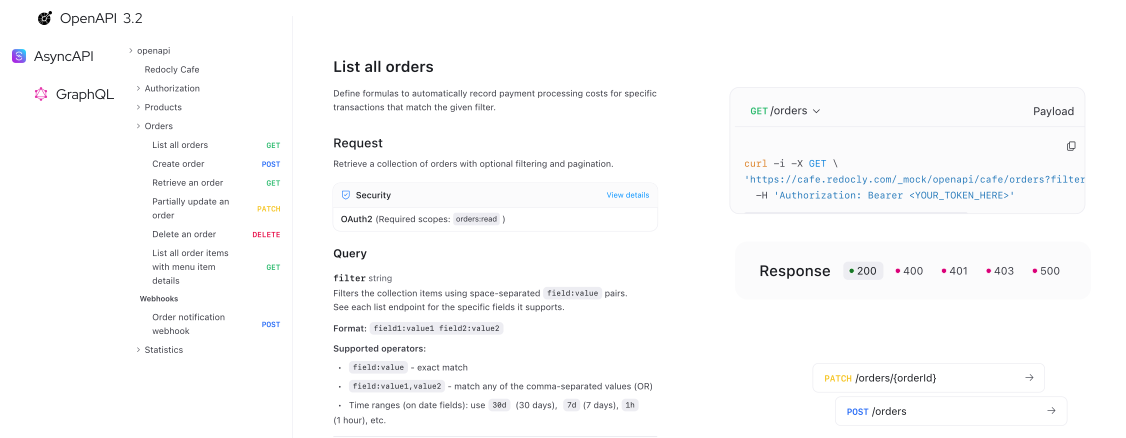
Redoc 3.0 is rebuilt from the ground up –
a new design, fast on your biggest specs, and readable by AI agents as easily as by people

A completely new design. Cleaner typography, refined spacing, and a polished UI across every layout.


New rendering engine. Renders what's on screen and keeps the rest parked, so thousand-endpoint specs stay smooth.

Layouts and theming, your way. Switch layouts at runtime and restyle everything through CSS design tokens.

One tool, multi-spec. OpenAPI, GraphQL, AsyncAPI, and MCP, all in one place.

Redesigned Search. Structured content keeps search fast on huge specs and jumps straight to the exact operation.

Built for AI agents. WebMCP tools let an agent in the reader's browser list operations, read one in full, and look up how to authenticate.
/ specs
One renderer for a growing spec ecosystem
Redoc 3.0 starts with three specification families and it's built to keep adding more, all through one consistent, polished UI.

OpenAPI 3.2
SupportedFull support for 2.0 through 3.2 — overlays, workflows, and modern security schemes included.

GraphQL
SupportedQueries, mutations, subscriptions, and full type-system docs rendered from your schema.

AsyncAPI
SupportedEvent-driven docs for channels, operations, and messages — same polish as REST references.

MCP
SupportedDocument Model Context Protocol servers — tools, resources, and prompts, rendered beautifully.

OpenRPC
Coming soonJSON-RPC APIs get first-class reference docs, with methods and params fully described.

gRPC
Coming soonProtobuf services, streaming methods, and message types in the same unified reference UI.
Preview your own API in Redoc 3.0
Open the live previewer, drop in a spec file or paste a URL, and watch it render instantly – no sign-up, no setup.
/ Customization
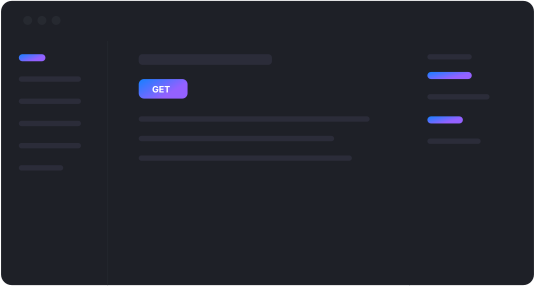
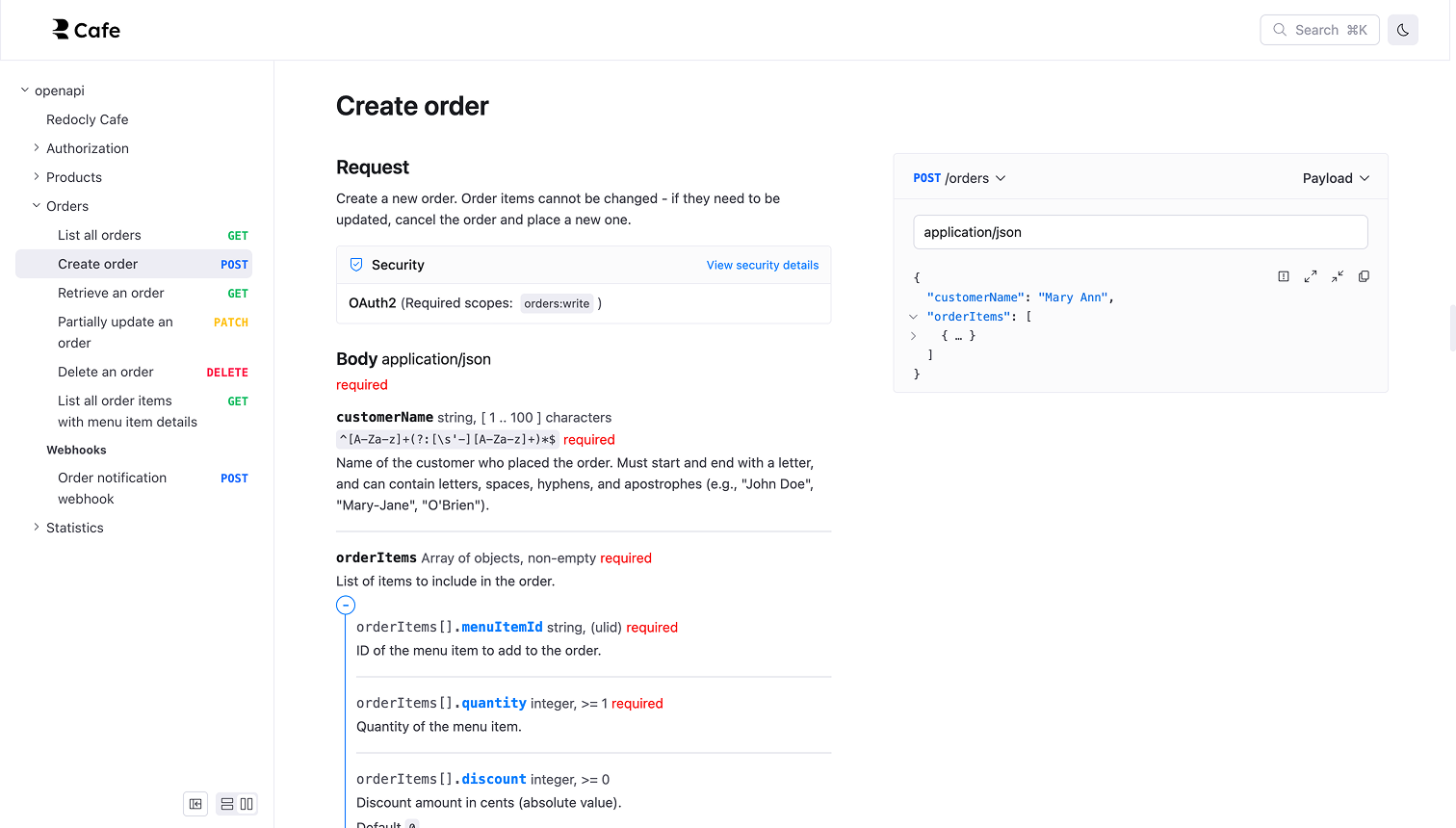
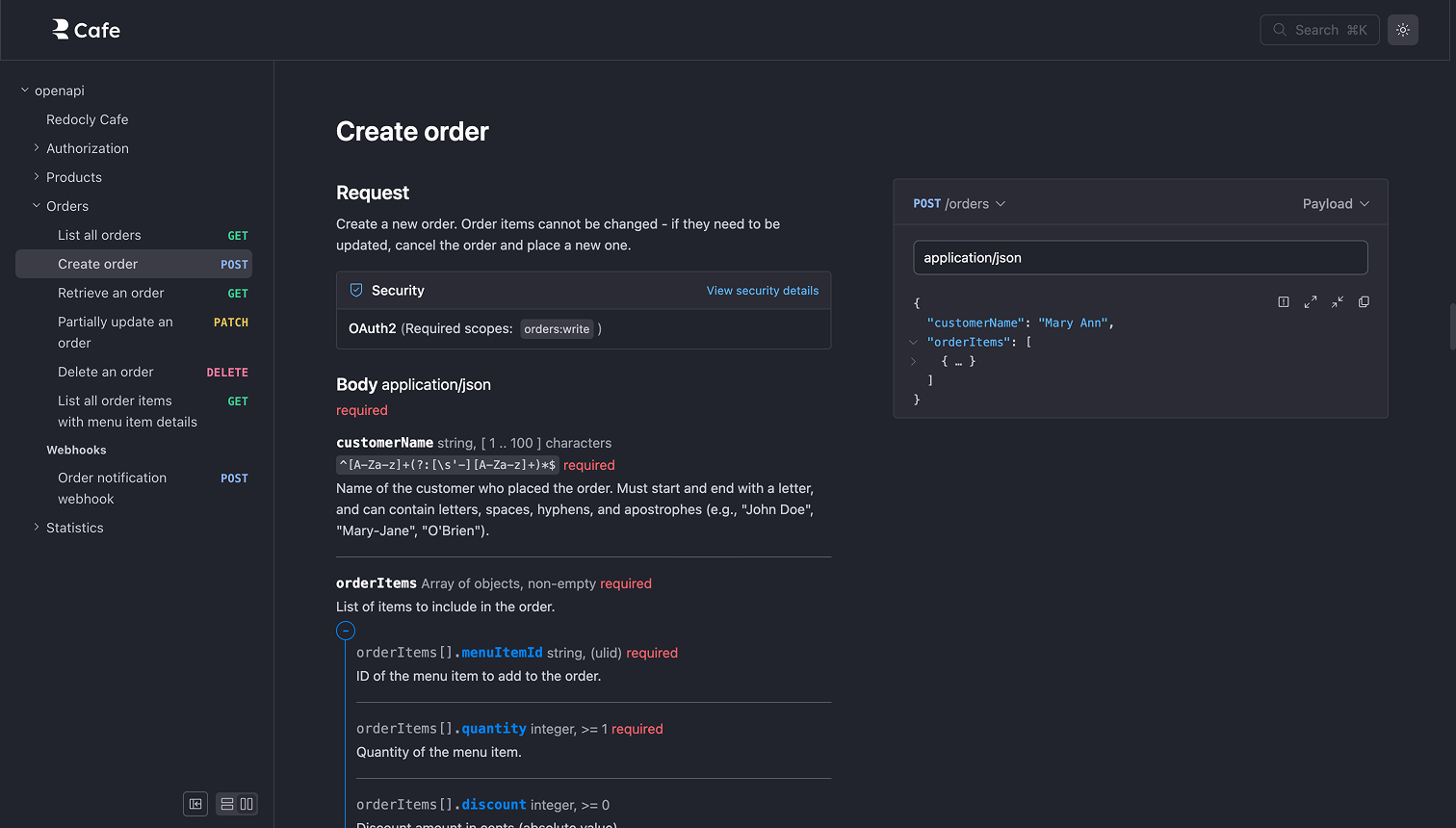
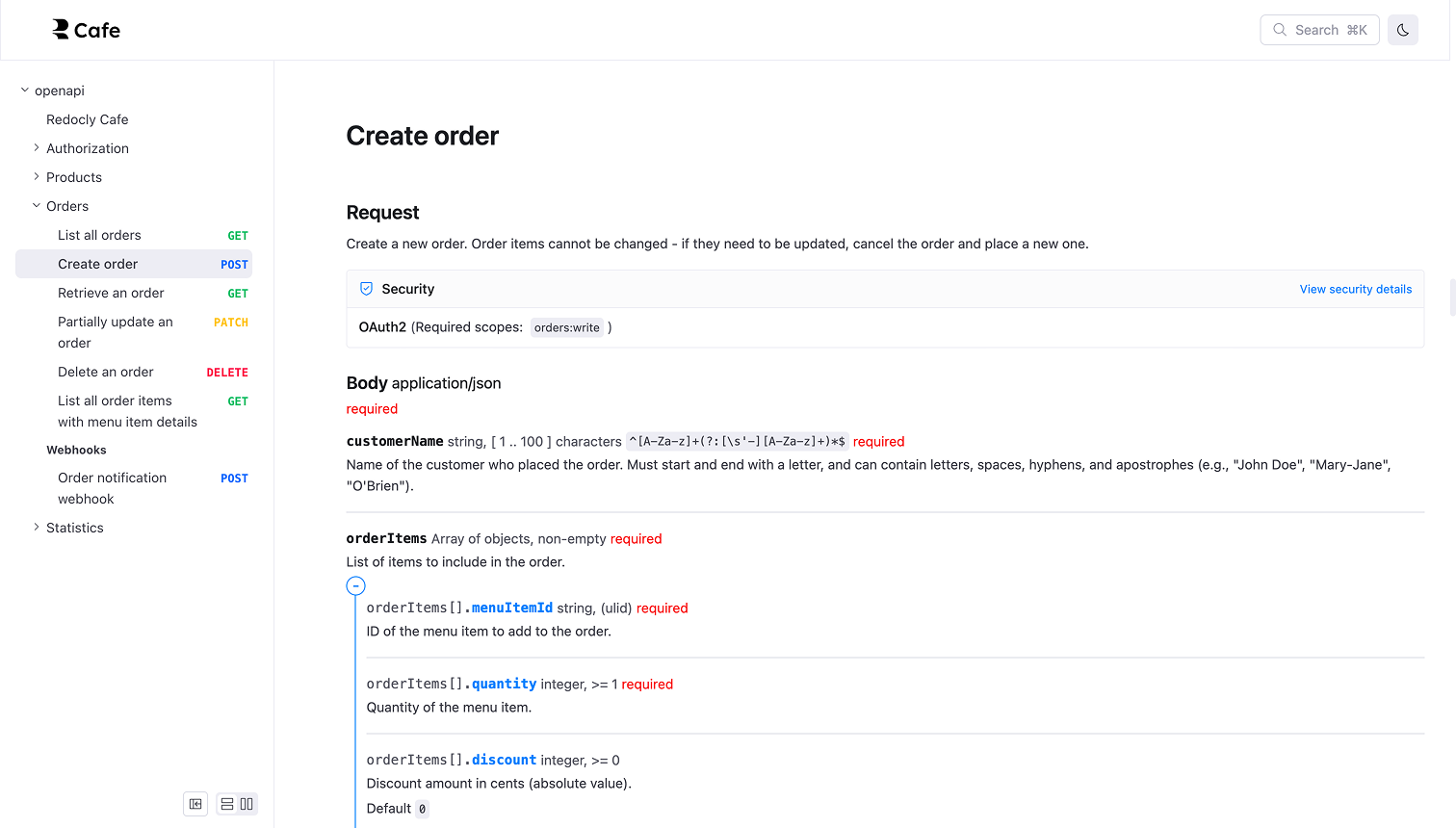
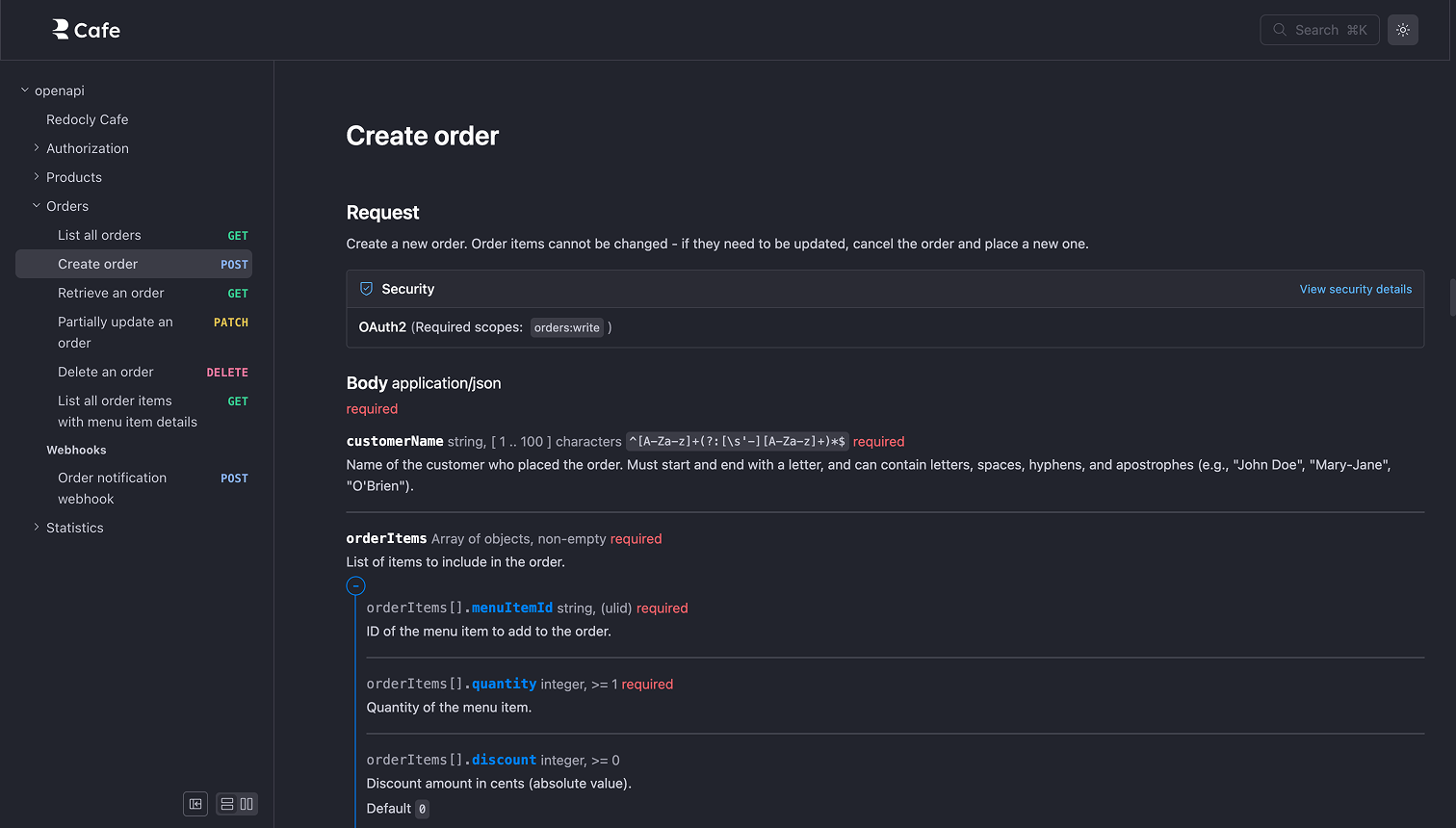
Flexible layouts. Effortless theming.
Layouts. Three Panel and Stacked views, switchable at any time.
Theming. Design tokens, your brand, and built-in dark mode.
/ Performance at scale
Built to stay snappy on thousand-endpoint descriptions
The new renderer draws what's on screen and leaves the rest parked until it's needed, so even sprawling, enterprise-sized specs stay smooth to scroll and search.

On-demand rendering
Operations and schemas are mounted just before they enter the viewport, so the initial load barely changes whether a spec has 50 endpoints or 5,000.

Fine-grained updates
Expanding a schema or switching a response code updates just that piece of the page.

Shared, de-duplicated schemas
Identical schemas are collapsed to a single shared entry and processed once, so memory and render cost stay flat as schemas grow and repeat.
/ Under the hood
A modern architecture
at every layer
The improvements you can see are built on a foundation that was rebuilt from the ground up. Here's what changed

New rendering core
Any supported spec is normalized once into a flat, render-ready model, then drawn on demand. The heavy work happens up front, so the UI stays light no matter how large the API.

Reactive state model
State lives in fine-grained, independent atoms; instead of one large store, a change to one operation re-renders only that operation, keeping interactions instant.

Real routing layer
True multi-page routing replaces hash-fragment navigation, giving every operation, tag, and schema a real, addressable URL.

Modern build tooling
An ESM-first build with code-splitting and tree-shaking keeps the bundle lean and loads only what each page needs.
/ Side by side
All the changes, at a glance
Everything you rely on today, with support for larger specs, more layout options, and more specification types.

Capability
Redoc 2.0
Redoc 3.0
Specification support
OpenAPI 2.0 / 3.0 / 3.1
✓OpenAPI 2.0 → 3.2, plus GraphQL, AsyncAPI and MCP
Rendering model
One long document rendered up front
✓On-demand rendering with viewport-aware windowing
Large specs
Slows down and can freeze on very large specs
✓Built to stay quick on thousand-endpoint specs
State model
Single global store
✓Fine-grained reactive atoms, updated per field
Deep linking
Anchor to an operation
✓Down to a field, response code, or message; legacy links still work
Layout
Fixed three-panel layout
✓Three Panel and Stacked, switchable at runtime
Theming
JavaScript theme object
✓CSS design tokens, with dark mode built in
Search
Per-load client index that slows on big specs
✓Rebuilt around structured, instantly indexable content
AI agents
Agents read the rendered page
✓WebMCP tools an in-browser agent can call directly
Specification support
OpenAPI 2.0 / 3.0 / 3.1
✓OpenAPI 2.0 → 3.2, plus GraphQL, AsyncAPI and MCP
Rendering model
One long document rendered up front
✓On-demand rendering with viewport-aware windowing
Large specs
Slows down and can freeze on very large specs
✓Built to stay quick on thousand-endpoint specs
State model
Single global store
✓Fine-grained reactive atoms, updated per field
Deep linking
Anchor to an operation
✓Down to a field, response code, or message; legacy links still work
Layout
Fixed three-panel layout
✓Three Panel and Stacked, switchable at runtime
Theming
JavaScript theme object
✓CSS design tokens, with dark mode built in
Search
Per-load client index that slows on big specs
✓Rebuilt around structured, instantly indexable content
AI agents
Agents read the rendered page
✓WebMCP tools an in-browser agent can call directly
Run Redoc your way
Self-host it free, or let us host it for you.
Open source
The full renderer, free forever and MIT licensed. Run it on your own infrastructure, no strings attached.
 25.8k Github starsStar Redoc on GitHub
Hosted by Redocly
We run the same Redoc for you on our platform – no servers, builds, or upgrades to manage. You get the polish and the pieces a team needs, without the maintenance.
 Start 30-day free trial
Keep up with
what's next for Redoc
Subscribe for product updates and new releases.