The Redocly OpenAPI VS Code extension now includes Type hints, a lightweight alternative to Cursor context for identifying node types. With type hints you can find the subject and property values you need for configurable rules by hovering over any node in your API description (OpenAPI, AsyncAPI, Arazzo, and others).
Suppose you need to change all operation IDs to use snake_case instead of camelCase. To avoid missing any operation, let's create a configurable linting rule that checks every operation ID in the OpenAPI document.
When writing your rule, you need to target a specific node with the subject and property to which the rule applies. To find these values, you can either use Cursor context or Type hints.
Use Type hints
To use Type hints to find the values of subject and property:
- Hover over
operationId. - Read
subjectandpropertydirectly from the tooltip.

This approach requires fewer steps and keeps you inside the immediate context of your work, without affecting your focus.
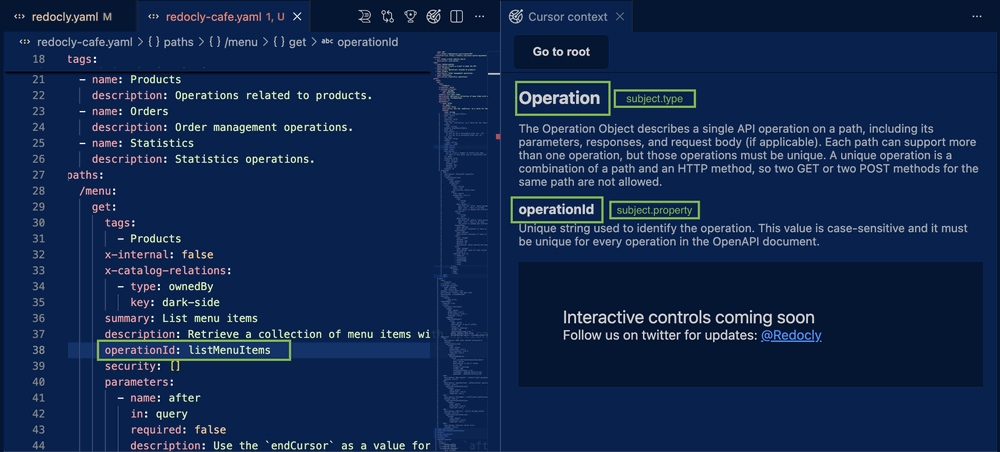
To use Cursor context to find the values of subject and property:
- Place your cursor on
operationId. - Open the Cursor context panel.
- Find
subjectandpropertyin the panel.
extends:
  - recommended
rules:
  struct: error
  rule/id-casing:
    subject:
      type: Operation
      property: operationId
    assertions:
      casing: snake_case